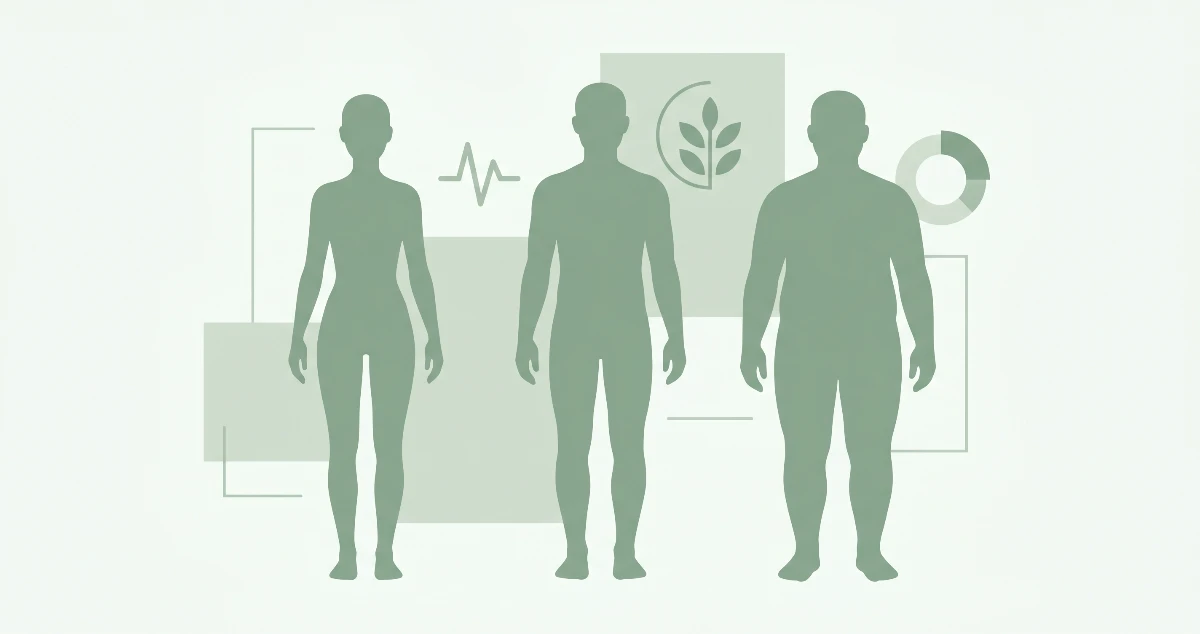
The science of body types (somatotypes)
The three-body-type model was first proposed by psychologist William Sheldon in the 1940s as part of a broader theory linking physique to personality. The personality aspects have been thoroughly discredited, but the underlying observation that people have meaningfully different baseline body compositions and metabolic tendencies has been supported by subsequent research.
Modern sports science uses somatotyping more loosely — as a descriptive framework for individual differences in body composition, metabolic rate, and response to diet and training, rather than as rigid biological categories. A 2019 review in the Journal of the International Society of Sports Nutrition confirmed that genetic variation in lean mass, fat distribution, and metabolic rate is substantial and explains meaningful differences in how individuals respond to identical diet and training programmes.
The practical implication: two people can eat the same number of calories and do the same exercise and experience very different outcomes. Body type gives you a starting framework for understanding why — and how to adjust your approach accordingly.
How to identify your body type
Most people are a blend of two body types rather than a pure category. Use these characteristics as a guide, focusing on your natural untrained state rather than your current physique after years of diet and exercise.
| Characteristic | Ectomorph | Mesomorph | Endomorph |
|---|---|---|---|
| Natural frame | Narrow, small joints | Medium, athletic | Wide, large joints |
| Default metabolism | Fast, high NEAT | Balanced | Slower, efficient |
| Muscle gain tendency | Slow but lean | Fast | Moderate, with fat |
| Fat gain tendency | Resistant | Moderate | High |
| Typical challenge | Gaining size | Maintaining leanness long-term | Losing fat |
| Famous examples | Distance runners, models | Most elite athletes | Powerlifters, rugby props |
A quick practical test: wrap your middle finger and thumb around your opposite wrist. If they overlap, you likely have a smaller frame (ectomorph tendency). If they just touch, you're likely mesomorph. If they don't reach, you likely have a larger frame (endomorph tendency). This is a rough heuristic, not a diagnostic tool.
Ectomorph diet and calorie guide
🏃 Ectomorph
- Struggles to gain weight or muscle despite eating significantly
- High NEAT — naturally fidgets, moves more, burns more at rest
- Often has a slender frame with less muscle and fat than peers
- Metabolic rate tends to upregulate with increased food intake
Calorie target for ectomorphs
Ectomorphs typically need to eat more than their calculated TDEE suggests — because TDEE calculators use population averages, and ectomorphs consistently sit above average for spontaneous activity and metabolic rate.
- For muscle gain: start at TDEE + 400–600 calories. If weight isn't increasing after 2 weeks, add another 200 calories
- For fat loss: a deficit of only 200–300 calories is recommended — larger deficits cause rapid muscle loss in ectomorphs who have little fat to spare
- For maintenance: eat at TDEE and monitor weight weekly; adjust upward if weight trends down
Ectomorph macro targets
Ectomorphs benefit from the highest carbohydrate intake of the three types, as carbs are the primary fuel for the high-volume training typically needed to stimulate muscle growth in hard gainers.
- Protein: 0.7–0.9g per pound of bodyweight. Adequate but not extreme — ectomorphs don't have large muscle masses to maintain
- Carbohydrates: 50–60% of total calories. High carb intake supports training volume and the calorie surplus needed for growth
- Fat: 20–25% of total calories. Sufficient for hormones and fat-soluble vitamins
Practical tips for ectomorphs
- Eat more frequently — 4–5 meals per day makes hitting a calorie surplus more manageable than 3 large meals
- Include calorie-dense foods: nut butters, olive oil, whole milk, avocado, dried fruit, oats
- Prioritise strength training over cardio — excess cardio burns the calories ectomorphs need for growth
- Track calories consistently — ectomorphs often underestimate intake and overestimate how much they eat
Mesomorph diet and calorie guide
💪 Mesomorph
- Gains muscle relatively easily with appropriate training
- Can lose fat without sacrificing too much muscle
- Medium frame with naturally athletic proportions
- Body responds predictably to changes in diet and exercise
Calorie target for mesomorphs
Mesomorphs have the most predictable response to calorie manipulation of the three types. Standard TDEE calculations tend to be accurate, and body weight responds proportionally to changes in intake.
- For muscle gain: TDEE + 200–400 calories — a conservative surplus minimises fat gain while supporting muscle growth
- For fat loss: TDEE − 300–500 calories — standard deficit produces clean fat loss with good muscle retention
- For maintenance: TDEE, recalculated every 4–6 weeks as composition changes
Mesomorph macro targets
Mesomorphs respond well to balanced macros and have the flexibility to adjust ratios based on personal preference without dramatic effects on body composition.
- Protein: 0.7–0.85g per pound — sufficient for muscle maintenance and growth
- Carbohydrates: 40–50% of calories — moderate carb intake supports performance without excess
- Fat: 25–30% of calories — standard fat intake for hormonal health and satiety
Get calorie targets personalised to your body type
FreeCalorieTracker asks your body type during setup and adjusts your calorie and macro targets accordingly — not just a generic formula.
Start free →Endomorph diet and calorie guide
🏋️ Endomorph
- Gains fat more easily than ectomorphs and mesomorphs at the same calorie intake
- Lower NEAT — naturally less fidgety, more efficient energy use
- Larger skeletal frame with naturally higher baseline muscle mass
- Often has good strength potential but struggles with leanness
Calorie target for endomorphs
Standard TDEE calculators tend to overestimate calorie needs for endomorphs because they assume population-average activity and metabolic efficiency. Endomorphs should start at the calculated TDEE and be prepared to reduce by 100–200 calories if weight doesn't move as expected.
- For fat loss: TDEE − 300–500 calories. A moderate deficit with high protein gives better body composition than an aggressive deficit
- For muscle gain: a very small surplus of TDEE + 100–200 calories or even maintenance calories — endomorphs can build muscle in a smaller surplus without the excess fat gain that a larger surplus causes
- For maintenance: TDEE, but track weight weekly as maintenance calories may be lower than calculated
Endomorph macro targets
Endomorphs tend to have higher insulin sensitivity variation, meaning carbohydrate management has a larger impact on body composition than it does for ectomorphs. Lower carb approaches consistently show better results for fat loss in people with endomorphic tendencies.
- Protein: 0.85–1.0g per pound — high protein supports muscle retention during fat loss and increases satiety
- Carbohydrates: 25–35% of calories — lower than average, prioritising complex carbs (oats, sweet potato, rice) timed around exercise
- Fat: 30–35% of calories — higher fat with lower carbs can improve satiety and reduce insulin variability
Practical tips for endomorphs
- Eat the majority of carbohydrates around training — pre and post workout when insulin sensitivity is highest
- Prioritise fibre-rich vegetables which provide volume and satiety with minimal calories
- Include resistance training — muscle tissue increases metabolic rate and improves insulin sensitivity over time
- Avoid relying on cardio alone for fat loss — it drives hunger without building the muscle that improves long-term metabolism
- Don't go too low on calories — severe deficits downregulate metabolism more aggressively in endomorphs than in other body types
Body type comparison at a glance
| Factor | Ectomorph | Mesomorph | Endomorph |
|---|---|---|---|
| Calorie surplus for muscle | +400–600 | +200–400 | +100–200 |
| Calorie deficit for fat loss | −200–300 | −300–500 | −300–500 |
| Protein (% of calories) | 25–30% | 25–30% | 35–40% |
| Carbs (% of calories) | 50–60% | 40–50% | 25–35% |
| Fat (% of calories) | 20–25% | 25–30% | 30–35% |
| Meal frequency | 4–5 meals | 3–4 meals | 3 meals + planned snacks |
The limits of body type theory
Body type frameworks are useful starting points, not rigid prescriptions. Several important caveats:
- Most people are hybrids. Pure ectomorphs, mesomorphs, and endomorphs are rare. Most people are ecto-meso, meso-endo, or somewhere in between. Use the framework directionally, not as a fixed label
- Genetics aren't destiny. An endomorph who trains consistently and manages their diet can achieve levels of leanness that "shouldn't" be possible for their type. Body type predicts tendencies, not outcomes
- The research base is thinner than many guides suggest. Much of the body type-specific dietary advice is extrapolated from metabolic and hormonal research rather than directly tested. Treat it as an educated framework rather than established protocol
- Individual response always trumps theory. If a high-carb approach is working for you as a supposed endomorph, don't change it because a guide says you should eat low-carb. Track, observe, and adjust based on your actual results
Frequently asked questions
Related guides
Track calories matched to your body type
FreeCalorieTracker personalises your calorie and macro targets based on your body type, goal, and activity level — completely free.
Get started free →