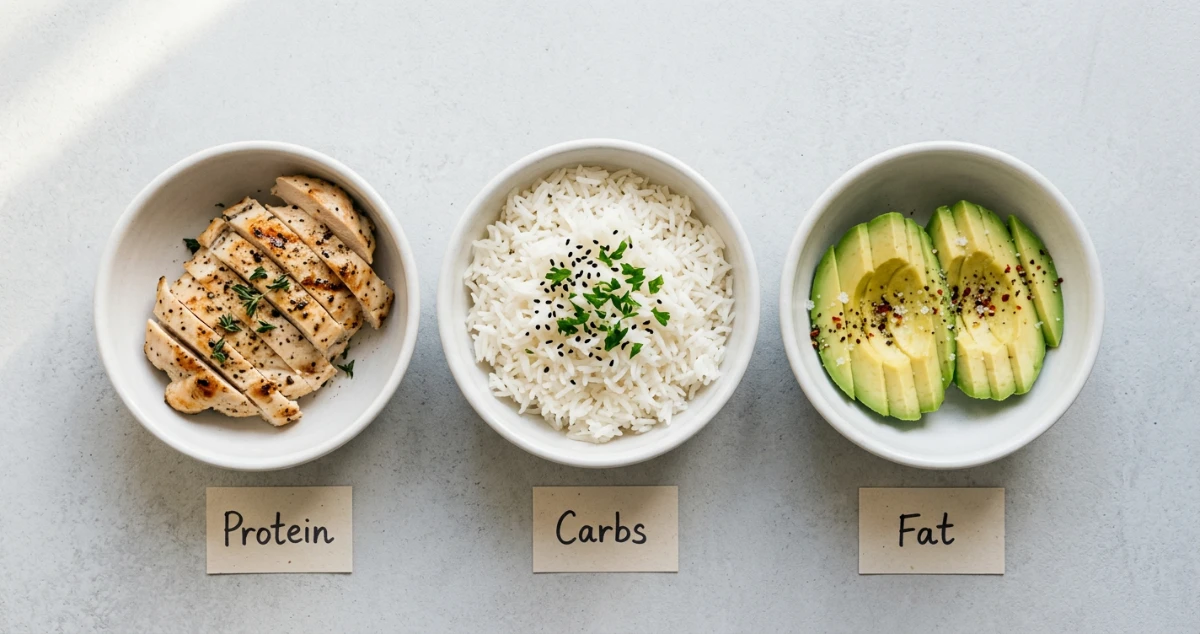
What are macros and why do they matter?
Macronutrients — protein, carbohydrates, and fat — are the three main categories of nutrients that provide energy. Every food you eat is made up of some combination of these three, and tracking them gives you a far more detailed picture of your diet than calories alone.
Why does it matter what your calories are made of? Because different macros affect your body very differently. Protein preserves and builds muscle tissue and has the highest thermic effect (your body burns more calories digesting it). Carbohydrates fuel high-intensity exercise and brain function. Fat supports hormone production, fat-soluble vitamin absorption, and satiety.
For simple weight management, calories in vs calories out is the primary driver. But for body composition — losing fat while keeping muscle, or building muscle without excessive fat — macro distribution can make a significant difference to your results.
Macro Calculator
Enter your details to get your personalised daily macro targets in grams. The calculator uses your TDEE and body weight to set evidence-based protein, fat, and carbohydrate targets for your specific goal.
⚖️ Your Macro Calculator
Targets update automatically based on your goal. For the most personalised results, use FreeCalorieTracker which recalculates your macros as your weight changes.
Your daily macro targets:
Track your macros daily in FreeCalorieTracker →How much protein do you need?
Protein is the most important macro to get right because it directly affects muscle retention and growth — which in turn affects your metabolic rate, strength, and body composition.
The current evidence-based recommendations from the International Society of Sports Nutrition (2017) and subsequent meta-analyses:
| Goal | Protein target | Notes |
|---|---|---|
| Fat loss | 0.8–1.0g per lb (1.8–2.2g per kg) | Higher end preserves more muscle in a deficit |
| Maintenance | 0.6–0.8g per lb (1.4–1.8g per kg) | Lower end is sufficient if not training hard |
| Muscle building | 0.7–0.9g per lb (1.6–2.0g per kg) | More protein beyond this shows diminishing returns |
| Sedentary adults | 0.36g per lb (0.8g per kg) | Minimum for tissue maintenance, not optimal for body composition |
The evidence strongly supports higher protein during fat loss — a 2022 meta-analysis in Obesity Reviews covering 36 trials found that higher protein diets (>25% of calories) produced 1.7kg more fat loss and 1.1kg more muscle retention than lower protein diets at the same calorie level.
Best protein sources by dietary preference
- Omnivore: chicken breast, eggs, Greek yogurt, cottage cheese, fish, beef
- Vegetarian: eggs, Greek yogurt, whey protein, cottage cheese, tofu, tempeh, lentils
- Vegan: tofu, tempeh, edamame, lentils, chickpeas, seitan, pea protein powder
- Keto/low-carb: eggs, fatty fish, meat, cheese, Greek yogurt
How many carbs should you eat?
Carbohydrate intake is the most flexible of the three macros. Unlike protein (which has a clear minimum for muscle) and fat (which has a minimum for hormones), carbs can be adjusted widely based on preference, performance needs, and dietary approach.
After setting protein and fat, carbohydrates fill the remaining calorie budget. This means carbs are directly tied to your total calorie intake and deficit or surplus:
- Higher carbs (45–55% of calories) are optimal for people doing high-intensity training (strength, HIIT, sport) as carbs are the primary fuel for anaerobic exercise
- Moderate carbs (30–40% of calories) is suitable for most people doing moderate activity with mixed training
- Low carbs (10–25% of calories) works for sedentary or lightly active people, those following ketogenic diets, or people who find carbs trigger overeating
How much fat per day?
Fat is essential — your body cannot produce certain fatty acids (omega-3 and omega-6) and needs dietary fat to absorb vitamins A, D, E, and K. Going too low on fat suppresses testosterone and oestrogen production, which affects muscle growth, mood, and metabolic rate.
The minimum recommended fat intake for hormonal health is approximately 0.3g per pound of bodyweight (0.6g per kg). For most people, a target of 20–30% of total calories from fat keeps hormones healthy while leaving room for adequate protein and carbohydrates.
Fat intake above 30–35% of calories tends to displace carbohydrates, which reduces exercise performance. The exception is ketogenic diets, which intentionally keep fat above 60% of calories to induce ketosis.
Macro targets by goal
| Goal | Protein | Carbs | Fat | Calories |
|---|---|---|---|---|
| Fat loss | 35–40% | 25–35% | 25–30% | TDEE − 300–500 |
| Maintenance | 25–30% | 40–50% | 25–30% | TDEE |
| Muscle gain | 25–30% | 45–55% | 20–25% | TDEE + 200–400 |
| Ketogenic | 20–25% | 5–10% | 65–75% | TDEE − 0–300 |
Track your macros automatically
FreeCalorieTracker calculates your exact protein, carbs, and fat targets during setup, then tracks them daily with every meal you log — via photo, barcode, or manual entry.
Start tracking free →How to actually track your macros
Knowing your targets is half the work. Consistently hitting them is the other half, and that's where most people struggle. Here's what actually works:
Start with protein only
If you've never tracked macros before, start by tracking protein only for 2–3 weeks before adding carbs and fat. Hitting your protein target alone produces most of the body composition benefit of full macro tracking, and the habit is much easier to build incrementally.
Plan high-protein meals first
Build each meal around a protein source, then fill in carbs and fats around it. This makes hitting your protein target much easier than trying to retrofit protein into a meal that was planned around carbs.
Use photo analysis for speed
The biggest obstacle to macro tracking is the time it takes. Photo analysis — taking a photo of your meal and letting an app estimate the macros — reduces logging time from 2–3 minutes per meal to under 30 seconds. The slight reduction in precision is worth the dramatic increase in consistency for most people.
Pre-log meals the night before
Planning tomorrow's meals today and logging them in advance lets you see if you'll hit your targets before you eat, rather than discovering at 10pm that you're 50g short on protein with no way to fix it.
Frequently asked questions
Related guides
Hit your macro targets every day
FreeCalorieTracker tracks protein, carbs, and fat for every meal — via photo scan, barcode, or manual entry. Completely free.
Get started free →