Protein
How Much Protein Do You Actually Need Per Day?
The recommended daily protein intake has been debated for decades. Here's what the current research actually says — and the exact amount for your body weight, goal, and activity level.
The recommended daily protein intake has been debated for decades. Here's what the current research actually says — and the exact amount for your body weight, goal, and activity level.
For most active adults trying to lose fat or build muscle, 0.7–1.0g of protein per pound of bodyweight per day (1.6–2.2g per kg) is the evidence-based target. Sedentary adults need less — around 0.36g per pound (0.8g per kg). The exact amount depends on your goal, training intensity, and whether you're in a calorie deficit.
The official Recommended Dietary Allowance (RDA) for protein is 0.36g per pound of bodyweight (0.8g per kg) per day. You'll see this number cited on nutrition labels and in general health guidelines. For most active people, it's not enough.
The RDA is set at the minimum to prevent deficiency in sedentary adults — not the optimal intake for people who exercise, want to maintain or build muscle, or are in a calorie deficit. A 2017 meta-analysis in the British Journal of Sports Medicine examining 49 studies found that protein intakes up to 1.62g per kg (0.73g per lb) per day significantly increased muscle mass gains from resistance training, compared to lower intakes. At the RDA level of 0.8g per kg, most active people leave significant performance and body composition benefits on the table.
A 2020 systematic review in Advances in Nutrition found that for adults over 65, protein needs are actually higher than the RDA — around 1.0–1.2g per kg — to prevent age-related muscle loss (sarcopenia). The RDA is a floor, not a target.
Based on current sports nutrition research (ISSN 2017, Stokes et al. 2018). Results in grams per day.
| Goal | Protein per lb bodyweight | Protein per kg bodyweight | Why |
|---|---|---|---|
| Fat loss | 0.8–1.0g | 1.8–2.2g | Higher protein in a deficit dramatically reduces muscle loss |
| Muscle gain | 0.7–0.9g | 1.6–2.0g | Supports muscle protein synthesis; more shows diminishing returns |
| Maintenance | 0.6–0.8g | 1.4–1.8g | Maintains lean mass without excess |
| Sedentary | 0.36–0.5g | 0.8–1.1g | Meets minimum needs without calorie excess |
| 55+ adults | 0.6–0.9g | 1.2–2.0g | Counteracts age-related muscle loss (sarcopenia) |
| Endurance athletes | 0.5–0.7g | 1.2–1.6g | Supports recovery; lower need vs strength athletes |
The "anabolic window" — the idea that you must consume protein within 30 minutes of training or the gains are wasted — is largely a myth. A 2013 meta-analysis in the Journal of the International Society of Sports Nutrition found that total daily protein intake was far more important than precise timing.
That said, timing is not entirely irrelevant. The current evidence suggests:
FreeCalorieTracker shows your protein target alongside calories every day, and highlights when you're on track. Photo scan any meal to see the protein content instantly.
Start tracking free →| Food | Protein per 100g | Notes |
|---|---|---|
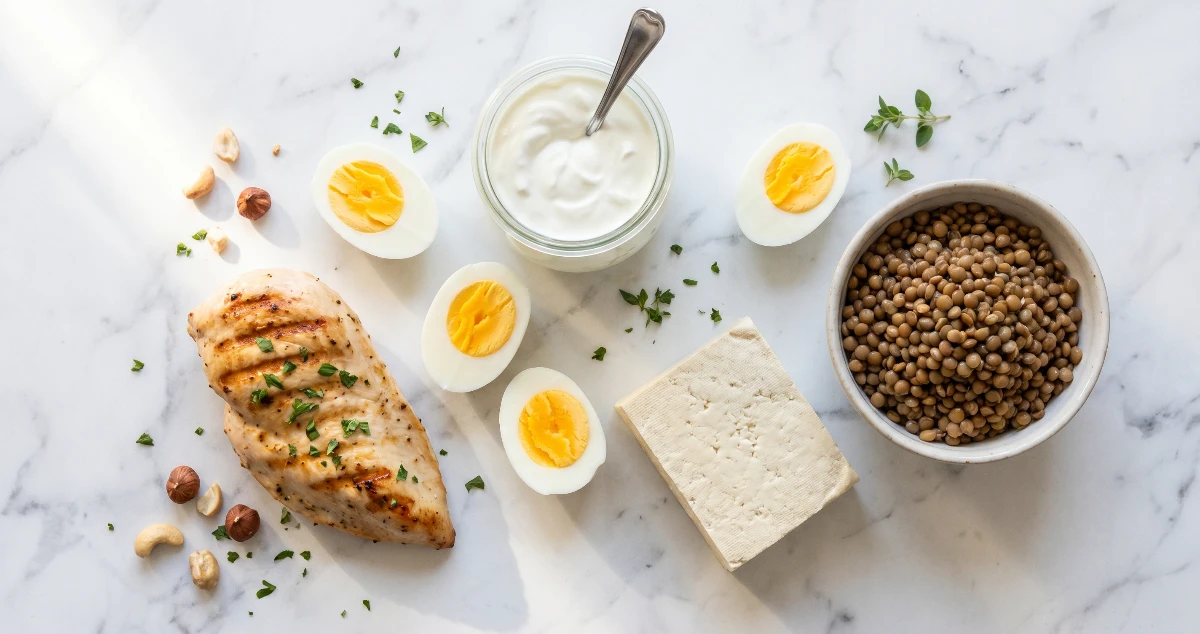
| Chicken breast (cooked) | 31g | Highest protein density of common meats |
| Canned tuna | 26g | Cheap, convenient, complete amino profile |
| Greek yogurt (0% fat) | 10g per 100g (17g per 170g serving) | High in casein — good pre-sleep option |
| Eggs | 13g per 100g (6g per egg) | Highest biological value of any whole food |
| Tofu (firm) | 17g | Best plant-based complete protein |
| Tempeh | 19g | Fermented soy — higher protein than tofu |
| Lentils (cooked) | 9g | High fibre, incomplete — combine with grains |
| Cottage cheese | 11g | High casein content, very satiating |
| Whey protein powder | 70–80g per 100g | Fast-absorbing — ideal post-workout |
| Edamame | 11g | Complete plant protein, convenient snack |
For healthy adults with normal kidney function, the evidence suggests high protein intake is safe. A 2016 study in the Journal of Nutrition and Metabolism found no adverse effects in resistance-trained individuals consuming over 4g per kg (1.8g per lb) per day over 12 months. That's approximately twice the upper end of typical recommendations.
The key caveat is kidney health. People with existing kidney disease or reduced kidney function should consult a doctor before high protein diets, as protein metabolism does increase kidney workload. For healthy individuals, this is not a concern at typical intake levels.
The practical upper limit for most people is not health-related but practical: very high protein diets are expensive, require significant food volume, and can crowd out other nutrients. Beyond approximately 1g per pound of bodyweight, additional protein provides no meaningful benefit for muscle growth or fat loss.
FreeCalorieTracker shows protein alongside calories on your home screen — and photo analysis shows you the protein content of any meal in seconds.
Get started free →