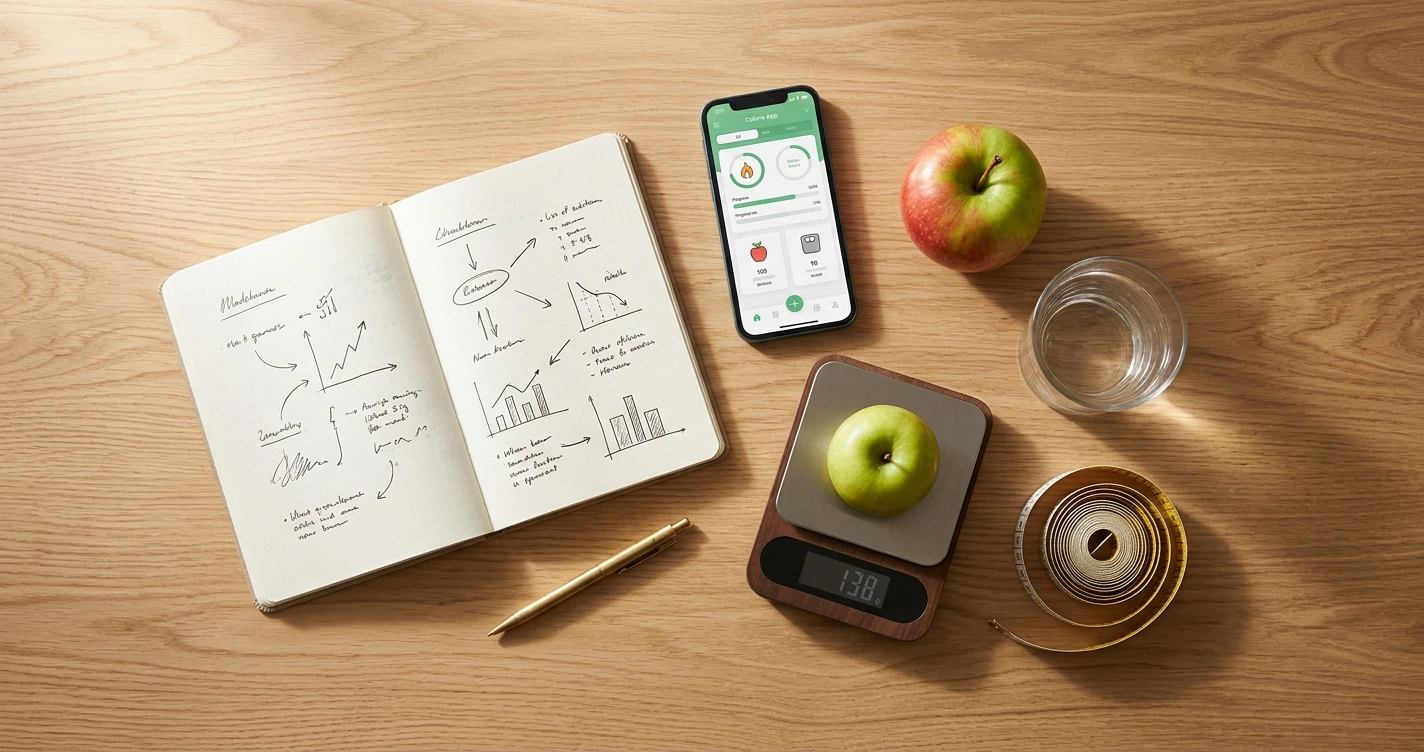
What calorie counting actually is (and isn't)
Calorie counting is tracking how much food energy you consume each day against a target — nothing more, nothing less. It is not a diet. It is not "macros". It is not a moral framework. It's an information system that turns "I'm eating healthy" (which means nothing) into "I ate 1,860 calories today" (which means something).
The reason it works is simple: perception of calorie intake is wildly inaccurate. A 1992 study in the New England Journal of Medicine followed people who reported difficulty losing weight on a "1,200 calorie diet". The actual intake measured by researchers averaged 2,081 calories. Nobody was lying — they were genuinely surprised at the gap between what they thought they were eating and what they actually were.
Counting calories closes this gap. It doesn't restrict what you can eat. It makes visible what you're already eating.
Is it worth the effort?
For most people pursuing a body composition goal, yes — and the effort is dramatically smaller than most people fear.
A 2008 study in the American Journal of Preventive Medicine followed nearly 1,700 dieters over 20 weeks. The single strongest predictor of weight loss success was consistent food logging — more than exercise, more than diet type, more than any other variable measured. People who logged 6+ days per week lost twice the weight of those who logged 1–2 days per week.
The reason it's so effective: tracking creates a feedback loop. You can't fix what you can't see. After two weeks of accurate logging, almost every beginner has at least one "I didn't realise that drink was 400 calories" moment that fundamentally changes their relationship with food choices.
Step 1: Set your calorie target
Calculate your TDEE
Your target starts from your Total Daily Energy Expenditure — the calories your body burns in 24 hours. Use the TDEE calculator with your stats. The output will land in one of three rough ranges:
- Sedentary adult woman: 1,700–2,100 calories
- Sedentary adult man: 2,200–2,700 calories
- Active adult (any sex): add 200–500 to the above
Apply your goal adjustment
From your TDEE, adjust based on your goal:
| Goal | Adjustment | Weekly result |
|---|---|---|
| Fat loss | −300 to −500 calories | Lose 0.25–0.5 kg/week |
| Maintenance | 0 | Weight stable |
| Muscle gain | +200 to +300 calories | Gain 0.25–0.4 kg/week |
For full detail on choosing the right deficit size, see the complete calorie deficit guide.
Add a protein target
Calories alone are sufficient for week one. After two weeks, add a protein target of 1.6–2.2 g per kg of bodyweight. This single addition will preserve muscle in a deficit and improve satiety dramatically. Carbs and fat ratios can wait until you're months into the habit.
Step 2: Choose how to track
Tracking quality matters more than tracking method. Pen-and-paper works if you commit to it. An app works better for most people because the food database does the calorie lookup for you.
The methods that genuinely work for beginners, in order of ease:
- Photo-based AI tracking — point your phone at a meal, the app estimates calories and macros. The lowest-friction option; full breakdown in how to count calories by photo.
- Barcode scanning — works for any packaged food. Open the app, scan the barcode, log the portion size. 10 seconds per item.
- Searched database entries — type the food name, pick from a list, enter the amount. The traditional method. Slower but reliable.
- Manual entry with kitchen scale — most accurate, slowest. Useful for week one to train your eye, then optional.
For comparing tracker options, see our breakdown of the best free calorie trackers — most beginners do best starting with one tool and sticking with it for at least 30 days before switching.
Step 3: Your first week of tracking
Days 1–2: Log everything, don't change anything
This is the most important advice in this entire guide. Do not try to eat differently in your first two days of tracking. Just log what you'd normally eat. The goal of days 1–2 is information, not behaviour change.
Why: trying to track AND change behaviour simultaneously creates two friction points instead of one. Most people quit by day four. If you log normally for two days, you get a baseline — the calorie total you've been consuming on autopilot. This is the number you'll work from.
Day 3: Review and adjust
Look at your day 1 and 2 totals. Compare to your target. The gap tells you what needs to change.
- Eating 500 calories under target: nothing to change — congratulations, you're already in the right place
- Eating at target: minor tweaks only
- Eating 500+ over target: identify the largest contributors and reduce portions, not foods
Days 4–7: Refine portions, not foods
In your first week, focus on portion sizes of foods you already eat — not switching to "diet foods". A normal-portion meal of pasta with chicken and salad is fine; a giant-portion of the same thing is the problem.
Track your meals without the maths
FreeCalorieTracker scans your food from a photo, looks up barcodes, and shows your daily progress against your personal calorie target. Free forever.
Start tracking free →End of week one: weigh in
Weigh yourself the morning of day 7 in the same conditions as day 1 (after toilet, before eating, no clothes). The number is information, not a verdict. Weight fluctuates by 1–2 kg daily for normal reasons (water, glycogen, food in transit). Trends emerge over weeks, not days.
Step 4: How accurate do you actually need to be?
The honest answer: significantly less accurate than you might think. Studies on macronutrient tracking show that subjects who tracked within ±10% of true intake achieved the same results as those who tracked within ±2%. Perfection is the enemy of consistency.
Where to be accurate:
- Calorie-dense foods. An eyeballed tablespoon of olive oil could be 90 or 180 calories — measure these.
- Foods you eat often. Errors on daily staples compound over weeks.
- Restaurant meals. Restaurant portions are routinely 1.5–2x what equivalent home cooking would be.
Where you can be loose:
- Non-starchy vegetables. They're nearly free calorically; don't sweat the broccoli.
- Lean proteins from familiar sources. Once you've weighed chicken breast a few times, eyeballing becomes accurate.
- Standard packaged foods. The label is the label; trust it.
8 mistakes beginners make in their first month
1. Setting too aggressive a deficit
The most common beginner mistake. A 1,200-calorie target sounds impressive; it's also unsustainable for most adults. Stick to 300–500 calories below TDEE. See the deficit calculator for guidance.
2. Forgetting drinks, sauces, and "tastes"
The classic gap between perceived and actual intake. A milk-based coffee, a tablespoon of dressing, three crisps from the bag while cooking — log them all in week one. After a month you'll have internalised the calorie cost.
3. "Just one cheat day" weekends
Eating perfectly Monday–Friday and consuming 4,000 calories on Saturday cancels the entire week's deficit. If you want to "have a day" occasionally, log it — you'll see the maths immediately.
4. Quitting after one bad day
You will have a day where you log nothing. Then a second. The temptation is to abandon the whole project. The right move is to log your next meal — not your next week. Consistency at 70% beats perfection at 100% that lasts three weeks.
5. Weighing yourself daily and reacting emotionally
Daily weigh-ins are useful for averaging out the trend, but the daily number is noise. Up 1 kg overnight after pizza is water and stomach contents — not fat. Track the weekly average instead.
6. Overcorrecting after a heavy meal
Skipping breakfast the day after a big dinner is not "balancing it out" — it's just adding restriction that triggers later overeating. Return to your normal target the next day.
7. Tracking only what you want to track
The protein bar gets logged; the handful of nuts at 4pm doesn't. Track everything or accept the result will be inaccurate.
8. Switching apps every week
Every app has minor irritations. Pick one and stick with it for at least 30 days. The friction of relearning interfaces dwarfs the benefit of any specific app feature.
When (and how) to stop counting calories
The goal of calorie counting isn't to count calories forever. It's to learn portion sizes, food choices, and habits well enough that you don't need to.
Signs you're ready to reduce tracking frequency:
- You can estimate the calorie content of most meals within ±100 calories before logging
- Your weight has been stable (or moving in the desired direction) for 8+ weeks
- You instinctively pick reasonable portions without thinking
- You know what your "usual" meals add up to without checking
The transition isn't all-or-nothing. Most people drop to logging 3–4 days a week, then weekly check-ins, then occasional tracking weeks when weight starts to drift. The skill stays; the daily friction reduces.
Some people stay logging long-term because they like the data. Some quit entirely after six months because they've learned what they needed to. Both are valid — the only failure mode is being trapped in a tracking habit that no longer serves you.